



Santosh Mahto
May 08, 2019
Share this post:


Reading time:
CEF (Chromium Embedded Framework) provides a simple framework for embedded browser/web functionality in your application. It is built on top of Chromium and mitigates the issue of a fast-changing Chromium API with stable APIs.
Over the past few years, Collabora has been involved in a number of customer projects to port/embed CEF on their platforms. One of the major projects related to this was to port CEF on Wayland.
To give some background (see previous blog), Chromium supports multiple backends with its Ozone layer abstraction. Once Chromium is built with Ozone enabled, a specific backend (e.g Wayland, Headless, X11) can be chosen at runtime.
Some time ago, Chromium made the decision to move to a servicification of UI-related components and introduced Mus (mandoline UI service). Ozone was only functional with the Mus framework, and not with the default Aura framework.
The work therefore involved updating CEF to use Mus and use Ozone-enabled Chromium for Wayland support. After quite a bit of effort, with several Collaborans participating, patches were made available for CEF to enable its usage on Wayland. And as our goal was always to upstream these changes to CEF, we began making these patches upstream ready.
However, at that time, building mainline CEF for Wayland still required external patches to be available on the ozone-wayland-dev project. This caused some issues for the patches getting accepted by upstream.
But time passed and the Chromium project changed its mind and deprecated Mus, moving back to its original architecture which allowed Ozone to be functional with the default Aura framework. This simplified everything, and enabled the Chromium main tree to be directly built for Ozone/Wayland.
This also led to some simplification of the patch for the CEF Ozone build and after a successful team effort, the patch has finally landed upstream!
https://bitbucket.org/chromiumembedded/cef/commits/491253fa0371
Now that the patch is directly available upstream, CEF is ready to be built with different Ozone platforms (Wayland, X11, Headless).
There are still some constraints to use CEF for Ozone due to many parts of the code dependant on X11.
The CEF Ozone build binary distribution can be created by passing flag --ozone to make_distrib.py.
Here are build instructions to build/run CEF on Wayland:
$ export GN_DEFINES="use_ozone=true"
$ cd /path/to/chromium/src/cef
$ ./cef_create_projects.sh
$ cd /path/to/chromium/src
$ ninja -C out/Release_GN_x64  cefsimple
$ weston &
$ ./out/Release_GN_x64/cefsimple --use-views --ozone-platform=wayland
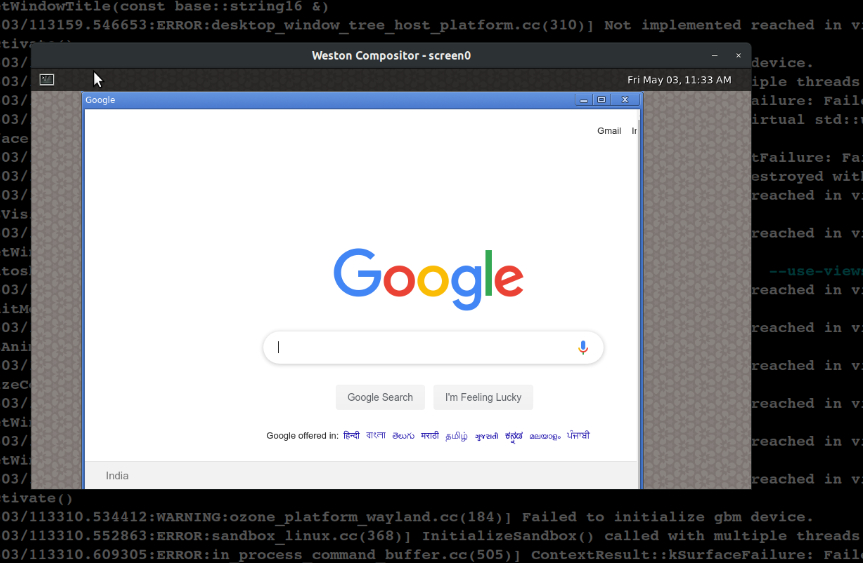
Screenshot:
Happy coding!
21/10/2026
Tyr has reached a major milestone by booting the Arm Mali-G610 GPU’s MCU using upstream Rust DRM memory-management abstractions, while helping…
26/08/2026
Tyr’s latest Rust GPU kernel driver work puts GPU memory management in place, from VM binding and GPUVM to GEM-backed buffers and firmware…
07/07/2026
AI development is shifting from implementing models from scratch to composing powerful capabilities via APIs, enabling developers to integrate…
26/05/2026
New upstream BlueZ documentation helps simplify Bluetooth qualification for Linux-based products by mapping supported profiles, test requirements,…
14/05/2026
See how Tyr moves beyond MCU firmware boot to build the group, queue, VM, submission, and completion paths needed to run real Vulkan workloads…
07/05/2026
A complete breakdown of Mesa’s NIR compiler detailing how it optimizes shader memory access with SSA promotion, deref analysis, copy propagation,…
Whether writing a line of code or shaping a longer-term strategic software development plan, we'll help you navigate the ever-evolving world of Open Source.


 한국어 버전의 Collabora.com 보기
 Acesse Collabora.com em Português