






Today sees the public release of Vulkan 1.0, the next-generation graphics API from the Khronos Group. As a member of Khronos, Collabora has been committed to improving EGL, OpenGL ES and OpenGL itself, and this continues with Vulkan.
With lineage dating back to 1992, OpenGL has served the industry well for many years, establishing itself as the standard for accelerated graphics rendering from large-scale cloud render farms to devices as small as the Raspberry Pi. Through this time, the nature of both graphics hardware and software has changed dramatically, from simple fixed-function pipelines to fully-programmable general-purpose co-processors.
In parallel with the evolution of OpenGL, Khronos has developed Vulkan as a radically different API to meet the needs of modern users. Vulkan offers users an unprecedented level of control and visibility over the graphics hardware, allowing maximum performance to be extracted.
Window system integration
Just as OpenGL and OpenGL ES use the standard EGL interface to manage devices and displays, Vulkan introduces WSI: the Window System Interface. The WSI allows applications to discover the different GPUs on the system, and display the results of GPU rendering to a window system.
This integration is an important, yet often-neglected part of the pipeline: all the careful work put in to your application can be let down at the last stage of actually displaying the result to the user. To provide the best possible base for fluid modern user interfaces, Collabora have worked extensively on the Wayland window system, the underlying Kernel Mode Setting drivers and atomic modesetting, and also the EGL specifications and implementations. We are proud to continue this work with Vulkan.
Day One Wayland support
The Vulkan WSI includes support for Wayland, amongst other window systems, from day one. Vulkan clients can run on unmodified Wayland servers, including Weston, GENIVI LayerManager, Mutter / GNOME Shell, Enlightenment, and more.
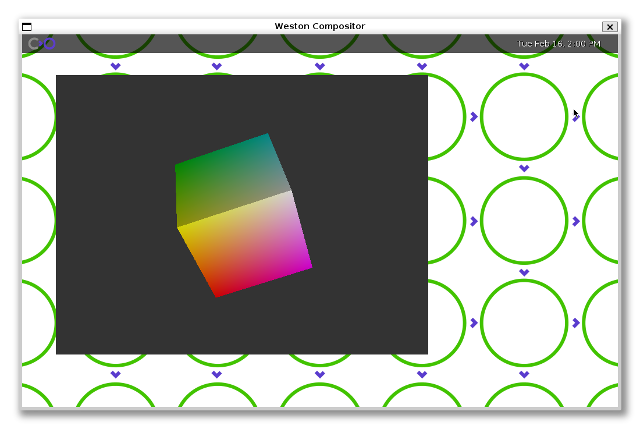 |
| Figure 1. 'vkcube' test client running on the Weston display server. |
Vulkan's WSI offers a powerful model to clients, allowing multiple buffer queues, ahead-of-time buffer reuse with explicit synchronisation, and more. As with Vulkan generally, the WSI model on Wayland allows an unprecedented amount of visibility and control, with fine-tuning and debugging easier than ever.
The road ahead
Collabora remains committed to advancing not only Vulkan, but also EGL and OpenGL ES for their existing large client bases. Just some of this work includes support for the EGL_EXT_device_base, GL_ARB_shading_language_420pack, and GL_ARB_arrays_of_arrays extensions, as well as improved specification conformance for OpenGL ES 3.1. We continue to develop Wayland and low-level kernel APIs suitable for the widest possible range of graphics users, from embedded user interfaces for the medical industry up to the latest AAA games.
To find out more about how Vulkan and OpenGL can work for you, please contact us.

 한국어 버전의 Collabora.com 보기
 Acesse Collabora.com em Português